
Cataracts Are Like Gray Hair!
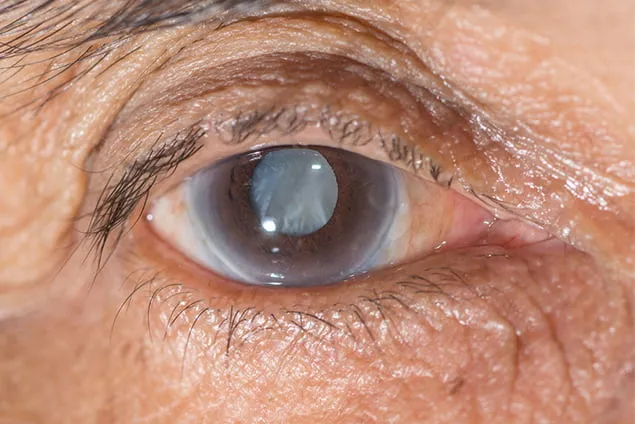
When I explain cataracts to a patient, I find that the most accurate analogy is gray hair.
This comparison is not merely a polite simplification—it is remarkably precise. Yet, it stops at one crucial point, and that point is the subject of this article.
Where Does the Comparison Hold True?
Both involve a change in protein. Your hair turns gray when its cells stop producing pigment. Similarly, your eye's lens becomes cloudy when the proteins that compose it begin to change and clump together—a process that starts for most people around the age of forty.
Both are gradual. Hair does not turn gray overnight, nor does the lens cloud over suddenly. Years may pass between the onset of the change and the moment you notice any impact on your vision.
Both happen to almost everyone. Most people over the age of sixty have some degree of lens clouding. This is neither a stroke of bad luck nor the result of a mistake you made. **It is not caused by anything you do.** Not reading in dim light, not watching television, and not "overusing" your eyes. Many patients ask about this, and the answer is no.
Three Myths Worth Correcting
"A film has grown over my eye." There is no film. A cataract is a change inside the lens itself—a transparent structure located behind the pupil. Nothing grows over the eye, and nothing is scraped off it.
"It is a disease I’ve contracted." Age-related cataracts are not a disease in the usual sense; rather, they are an expected physiological change—much like graying hair.
"It can be treated with eye drops." No eye drop can restore the lens's transparency. No medication, exercise, or diet can do so either. Anyone claiming otherwise is selling you a myth.
Where the Comparison Ends
Here lies the fundamental difference:
Graying hair does not affect the hair's function. Cataracts, however, affect your vision.
The lens is not merely decorative; it is part of the visual system. When it becomes cloudy, light passing through it scatters before reaching the retina, causing image quality to gradually decline:
-
General blurriness that new glasses cannot correct
-
Intense glare from streetlights and car headlights at night
-
An increasing need for brighter light when reading
-
Colors appearing faded or yellowish
-
Occasional double vision in one eye
-
Frequent changes in eyeglass prescriptions
A distinctive sign of cataracts is difficulty driving at night before any problems arise during the day. An interesting point that often confuses patients is that your ability to read without glasses may temporarily improve at a certain stage of cataract development. This is not a true improvement; rather, it is a change in the refractive power of the clouded lens, and it usually precedes a decline in vision.
When is the surgery performed?
There is no specific number, percentage, or stage of "ripeness" that one must wait for. The common notion that a cataract must be "ripe" before removal is outdated and no longer accurate.
The only criterion is your life. Surgery is performed when the cataract begins to interfere with the activities you need or love to do—such as driving, reading, working, or recognizing your grandchildren's faces.
If symptoms are mild, a new eyeglass prescription and better lighting may suffice for a time.
The procedure itself is one of the most commonly performed surgeries in the world: the clouded lens is replaced with a clear artificial lens under local anesthesia (using drops). It is a quick procedure, and the patient returns home the same day. The artificial lens never becomes cloudy, meaning the cataract does not recur.
Can it be delayed?
It cannot be prevented, but its progression can be slowed:
-
Sunglasses that block UV rays. This is the most important—yet most neglected—preventive measure, especially given that we live in a country with strong sunlight year-round.
-
Quitting smoking.
-
Controlling diabetes, as it significantly accelerates cataract formation.
-
Caution regarding long-term use of cortisone without medical supervision.
Summary
If your doctor has told you that you have early-stage cataracts, there is no need to worry. It is more akin to noticing a single gray hair than to being diagnosed with a disease.
However, when it begins to take something away from your life—such as driving at night, reading comfortably, or feeling confident going out in the evening—that is the time to seek a consultation. At that point, you have access to a definitive, permanent solution—something that simply does not exist for gray hair.
This article is general education, not a medical diagnosis, and does not replace an in-person consultation with the doctor.